dimecres, 21 de juliol del 2010

dimecres, 14 de juliol del 2010
Big hips 'impair' women's memory, a study finds
A woman's body shape may influence how good her memory is, according to US researchers.
Although carrying excess weight anywhere appears to impair older women's brains, carrying it on the hips may make matters worse, they say.
The Northwestern Medicine team found "apple-shaped" women fared better than "pears" on cognitive tests.
But depositing fat around the waist increases the risk of cancer, diabetes and heart disease, experts warn.
They said the findings, in the Journal of the American Geriatrics Society, highlighted the importance of maintaining a healthy weight for both body and mind.
Some of the health risks associated with obesity, such as vascular disease and inflammation, may explain why people who are overweight appear to be at higher risk of dementia.
However, the latest study suggests a bit of extra fat around the waist may actually protect brain functioning.

The researchers believe belly fat makes more of the female hormone oestrogen that naturally dips after the menopause.
Oestrogen is thought to help protect the brain from cognitive decline.
The study involved 8,745 post-menopausal women aged 65 to 79.
These women were asked to complete a memory test that doctors use to judge brain function. They were also weighed and measured, then scored on an obesity scale known as Body Mass Index or BMI. Over two-thirds of the women were overweight or obese.
The researchers found that for every one point increase in a woman's BMI, her memory score dropped by one point.
And pear-shaped women - those with smaller waists but bigger hips - scored particularly poorly.
The researchers say this is likely to be related to the type of fat deposited around the hips versus the waist.
Scientists already know different kinds of fat release different hormones and have varying effects on insulin resistance, lipids and blood pressure.
Lead researcher Dr Diana Kerwin said: "We need to find out if one kind of fat is more detrimental than the other, and how it affects brain function.
"The fat may contribute to the formation of plaques associated with Alzheimer's disease or a restricted blood flow to the brain."
Rebecca Wood, chief executive of the Alzheimer's Research Trust, said: "The pear-shape is incredibly common, and while this study doesn't explain fully the link between body shape and brain function, it surely makes the case for watching the scales.
"There is little we can do about our natural body shape, but a lot we can do about our weight.
"With so much evidence of the dangers of obesity, we could all do well to consider sensible lifestyle changes to keep our weight in check."
dimecres, 7 de juliol del 2010
7/7 victim's remarkable healing
 A woman who suffered severe facial burns during the 7/7 terror attacks in London five years ago is showing off her new face to the world.
The image of Davinia Turrell holding a gauze mask to her injured face came to symbolise the horror of the bombings.
Five years on, her facial scars are gone thanks to specialists at London's Chelsea and Westminster Hospital.
To show her gratitude she is backing the hospital's £50,000 fundraising appeal to help fellow burns victims.
The 29-year-old, who is now called Davinia Douglass after marrying last year, survived the fallout of the detonated bomb at Edgware Road station, but the "ball of fire" created in the carriage scorched the skin from the left side of her face.
Davinia told the Evening Standard: "I walked through the entire length of the train. I remember people screaming and sounding shocked as I walked through the back carriages.
"I didn't realise I was injured, I was still in shock. I remember telling people that I needed to get to work."
Photographers captured her as she was helped across the road to a makeshift A&E station by former fireman Paul Dadge while wearing the protective mask.
Mrs Douglass was subsequently treated at the Chelsea and Westminster Hospital - the only hospital to offer a specialist burns service in London.
She said: "I went from being convinced that I would be seriously scarred for life and that my life would be ruined, to being hopeful that the medics who were looking after me would be able to put me back together as I had been before."
The hospital's appeal hopes to provide the unit with its own burns psychological screening programme to ensure all burns in-patients receive psychological assessment - something that was not previously available to Mrs Douglass.
The Chelsea and Westminster Health Charity has already raised £50,000 towards the £100,000 target needed to fund a clinical psychologist for two years.
Greg Williams, burns service lead at Chelsea and Westminster Hospital NHS Foundation Trust said: "At present, patients with burns receive excellent care to ensure their physical recovery but we do not have the resources to provide psychosocial assessments for all the children and adults we admit.
"Were we to have a screening programme in place we feel strongly that we could identify potential psychological issues, address them early and help with recovery."
An unofficial ceremony was held in London's Hyde Park on Wednesday to mark the fifth anniversary of the 7 July bombings.
Survivors and families of those who lost their lives laid flowers by 52 steel pillars which represent those killed.

dimarts, 6 de juliol del 2010
Nelson Mandela
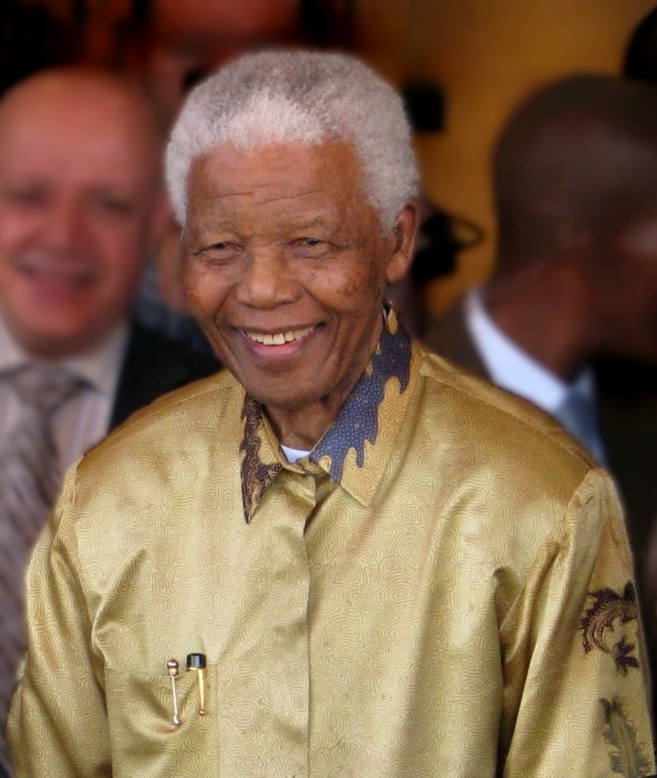
 Nelson Rolihlahla Mandela (Xhosa pronunciation: [xoˈliɬaɬa manˈdeːla];), born 18 July 1918,[1] served as President of South Africa from 1994 to 1999, and was the first South African president to be elected in a fully representative democratic election. Before his presidency, Mandela was an anti-apartheid activist, and the leader of Umkhonto we Sizwe, the armed wing of the African National Congress (ANC). In 1962 he was arrested and convicted of sabotage and other charges, and sentenced to life in prison. Mandela served 27 years in prison, spending many of these years on Robben Island. Following his release from prison on 11 February 1990, Mandela led his party in the negotiations that led to multi-racial democracy in 1994. As president from 1994 to 1999, he frequently gave priority to reconciliation.
In South Africa, Mandela is often known as Madiba, an honorary title adopted by elders of Mandela's clan.
Mandela has received more than 250 awards over four decades, including the 1993 Nobel Peace Prize.
diumenge, 4 de juliol del 2010
News : Genes predict living beyond 100
US scientists have developed a way of predicting how likely a person is to live beyond the age of 100.
The breakthrough, described in the journal Science, is based on 150 genetic "signposts" found in exceptionally long-lived people.
The Boston team created a mathematical model, which takes information from these signposts to work out a person's chance of reaching 100.
It is based on the largest study of centenarians in the world.
This is a rare trait - only one in 6,000 people in industrialised countries reaches such a ripe old age. And 90% them are still disability free by the age of 93.
The researchers now think they have cracked the genetic secret of this longevity.
The team originally embarked on their study in 1995. Since then, they have scanned the genomes of 1,000 centenarians.
They identified genetic markers that are "most different" between centenarians and randomly selected individuals.
The research was led by Paola Sebastiani, a professor of biostatistics at Boston University, and Thomas Perls, associate professor of medicine, also at Boston University.
"We tested our model in an independent set of centenarians and achieved an accuracy of 77%," explained Professor Sebastiani.
"So out of 100 centenarians we could correctly predict the outcome of 77."
She said that the "23% error rate" indicated that, although "genetics is fundamental in exceptional longevity it's not the only thing".
"So there may be other factors like environment or other lifestyles that may help people live longer and healthier lives."
Professor Perls explained that a previous study had looked at longevity in a group of people belonging to the Seventh-day Adventist Church.
"Those individuals have probably among the highest average life expectancy that we know of in the US of 88 years," he said.
Paola Sebastiani Boston University Fergus on ageWhat makes these people live a very long life is not a lack of genetic predisposition to diseases, but rather an enrichment of longevity.
"They get there by virtue of the fact that they have a religion that asks them to be vegetarian, they regularly exercise, they don't drink alcohol, they tend to manage their stress well through religion and time with family and they don't smoke.
"To live the additional 10-15 years beyond the age of 88, our paper is indicating that genetics are playing an increasingly important role."
The scientists said that, when it came to genes associated with a predisposition to age-related diseases, centenarians and non-centenarians did not really differ.
"This is very surprising," said Professor Sebastiani. "It suggests that what makes these people live a very long life is not a lack of genetic predisposition to diseases, but rather an enrichment of longevity."
Professor Perls said it was feasible that a simple test could be developed to screen people's chances of being so long-lived.
"I think that that's a possibility down the road," he said. "It brings up this whole field of personal medicine and being able to use genetic information in the future to help guide therapy."
But he added that there should be "a great deal of caution in thinking about what people might actually do with the information".
"Will that stop companies from going ahead and [developing some kind of chip-based test]? Probably not," he said,
"But we think it's really important to understand what people end up doing with this information, including thinking about social entitlements - that merits a lot more discussion."
Professor Sebastiani added: "We have a long list of things to do here.... to understand the real biology behind what we have found."

Thomas Perls Boston UniversityExceptional longevity is not this vacuous entity that no one can figure out
One of the co-authors of the Science paper is already building a free-to use website where people will be able to use the mathematical model.
On that site, which could be up and running within a week, people who know their genetic code could work out their predisposition to exceptional longevity.
"The site would provide some description of how to interpret the results in the right context," Professor Sebastiani explained.
Dr Jeffrey Barrett, a geneticist from the Wellcome Trust Sanger Institute in Cambridge, UK, cautioned that "subtle biases could make the test seem more accurate than it really is".
"Some of the genetic variants in this study are claimed to have much, much stronger effects on longevity than we've seen in similar studies of diabetes, heart disease and cancer," he told BBC News.
"Evaluation of the test by an independent laboratory will be the ultimate test of its accuracy."
Professor Perls summed up the findings as "a very optimistic message".
"Exceptional longevity is not this vacuous entity that no one can figure out," he said.
"I think we've made quite some inroads here in terms of demonstrating a pretty important genetic component to this wonderful trait, and this really opens the door to future research."
Eccentric people


Fra ncis Henry Egerton, 8th Earl of Bridgewater (11 November 1756 – 11 February 1829), known as Francis Egerton until 1823, was a noted British eccentric, and supporter of natural theology.
He was a son of John Egerton, Bishop of Durham and Anne Sophia Grey. His maternal grandparents were Henry Grey, 1st Duke of Kent and his second wife Sophia Bentinck. Sophia was a daughter of William Bentinck, 1st Earl of Portland and Anne Villiers. Anne was a daughter of Sir Edward Villiers and his first wife Frances Howard. She was also a sister of Edward Villiers, 1st Earl of Jersey.
Egerton was educated at Eton and Christ Church, Oxford, and became fellow of All Souls in 1780, and Fellow of the Royal Society in 1781. He inherited his title and a large fortune in 1823.
Egerton was known for giving dinner parties for dogs, where the dogs were dressed in the finest fashions of the day, down to fancy miniature shoes. Each day Egerton wore a new pair of shoes and he arranged the worn shoes into rows, so that he could measure the passing time. An animal lover, Egerton kept partridges and pigeons with clipped wings in his garden, allowing him to shoot them despite failing eyesight. Egerton never married, and upon his death, his title became extinct. He was buried at Little Gaddesden.
He bequeathed to the British Museum the valuable Egerton Manuscripts, consisting of 67 manuscripts dealing with the literature of France and Italy, and £12,000 to establish the Egerton Fund from which the Museum could purchase additional manuscripts. More than 3800 manuscripts have been purchased using the Egerton fund. He also left £8000 at the disposal of the president of the Royal Society, to be paid to the author or authors who might be selected to write and publish 1000 copies of a treatise "On the Power, Wisdom and Goodness of God, as manifested in the Creation". Mr Davies Gilbert, who then filled the office, selected eight persons, each to undertake a branch of this subject, and each to receive £1000 as his reward, together with any benefit that might accrue from the sale of his work, according to the will of the testator.
These Bridgewater treatises first appeared during the years 1833 to 1840, and afterwards in Bohn's Scientific Library.